Introduction: When Your Agent Confidently Lies to Production
Picture this. It's 2:14 a.m. and your customer-support agent, the one leadership loves demoing, has just promised a customer a 40% refund "per our updated policy." There is no updated policy. The agent invented it, wrote a polite email, and then called the billing API to issue the credit.
Nobody hacked anything. No prompt injection. The model simply did what large language models sometimes do: it filled a gap with something plausible, and the surrounding system trusted it.
In 2024, that kind of failure was mostly embarrassing. A chatbot said something silly and someone posted a screenshot. In 2026, agents don't just talk. They open pull requests, move money, update CRMs, file tickets, and trigger deployments. A hallucination is no longer a wrong sentence. It's a wrong action.
That shift is why a new kind of engineering work has quietly appeared inside DevSecOps teams: building Hallucination Firewalls. These are validation layers that sit between an agent's "brain" and the systems it touches, checking every claim and every tool call before it's allowed through.
In this deep-dive, we'll cover:
- What a Hallucination Firewall actually is (and what it isn't)
- A reference architecture you can adapt
- Working Python code for the core validation pipeline
- Real-world patterns from finance, healthcare, and DevOps agents
- Best practices, common mistakes, and pro tips
- Why this is one of the more interesting career bets for developers right now
Let's get into it.
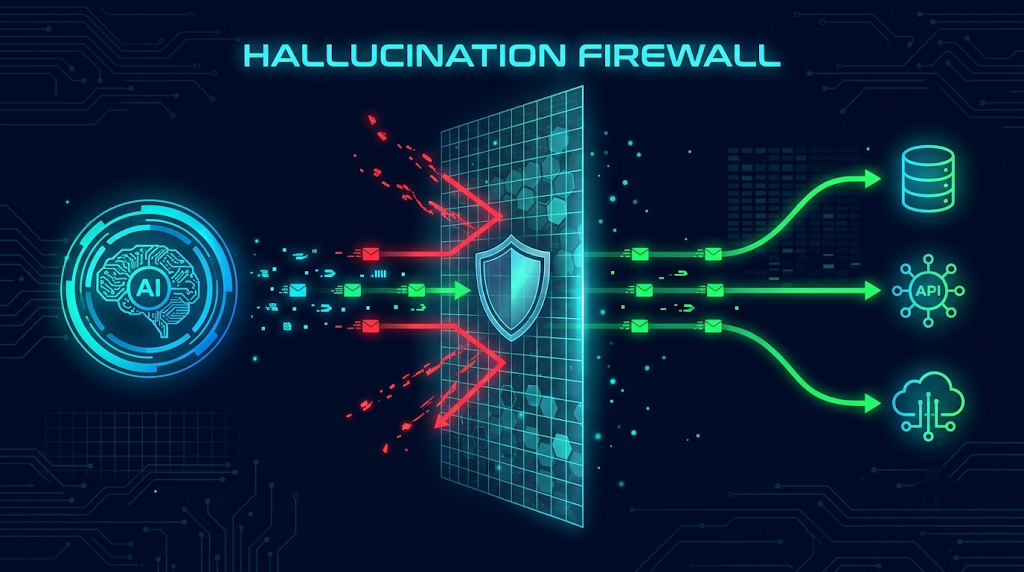
What Exactly Is a Hallucination Firewall?
A Hallucination Firewall is a runtime layer that intercepts AI-generated output (text, structured data, and tool calls) and decides one of four things:
- Allow it as-is
- Repair it (fix formatting, strip unsupported claims, redact sensitive data)
- Block it and return a safe fallback
- Escalate it to a stronger verifier or a human
The name borrows from network firewalls on purpose. A network firewall doesn't care why a packet looks suspicious. It applies rules at a choke point. A Hallucination Firewall works the same way: it doesn't try to fix the model's reasoning. It enforces what is allowed to leave the model's sandbox.
Why "Firewall" and Not Just "Guardrails"?
You've probably heard the word guardrails a lot. The terms overlap, but in practice teams use them differently:
| Aspect | Guardrails (typical usage) | Hallucination Firewall |
|---|---|---|
| Scope | Often prompt or response-level rules | Every boundary: responses, tool calls, memory writes, agent-to-agent messages |
| Ownership | Usually the AI or product team | Shared with platform, security, and SRE |
| Enforcement | Often advisory or best-effort | Fail-closed by default for high-risk actions |
| Observability | Sometimes minimal | Full audit trail, metrics, alerts, replay |
| Mental model | "Keep the model on topic" | "Treat model output as untrusted input" |
That last row is the important one. The core mindset of a firewall engineer is simple: the LLM is an untrusted component. Talented, useful, but untrusted. Exactly like user input from a web form.
The Three Types of Agent Hallucination You're Defending Against
Not every hallucination looks the same, and your firewall needs different checks for each:
- Factual hallucinations: the agent states something false ("Order #8812 shipped yesterday" when it didn't).
- Structural hallucinations: the agent produces malformed output, like a JSON field that doesn't exist, a wrong enum value, or an invented function name.
- Action hallucinations: the agent calls a real tool with fabricated or out-of-policy arguments, such as refunding the wrong amount, deleting the wrong resource, or emailing the wrong customer.
Action hallucinations are the scariest because they produce side effects. Most of the engineering effort in a serious firewall goes into catching them.
Why This Became a Top Enterprise Priority in 2026
A few forces collided over the last eighteen months or so:
- Agents got permissions. Protocols like the Model Context Protocol (MCP) made it trivially easy to wire an agent to dozens of tools. Easy integration means the attack and failure surface grew faster than most governance processes.
- Multi-agent systems went mainstream. When one agent's output becomes another agent's input, a single hallucination can compound across a chain. Errors stop being isolated.
- Regulation caught up. Frameworks such as the EU AI Act and the NIST AI Risk Management Framework push organizations toward documented risk controls, human oversight, and logging for higher-risk AI systems. Auditors increasingly ask, "Show me the control that stops this."
- Security teams joined the conversation. The OWASP Top 10 for LLM Applications explicitly calls out risks like improper output handling, excessive agency, and misinformation. Once a risk is on an OWASP list, it lands on a security team's roadmap.
The result: companies that happily shipped agents as experiments are now asking a very DevSecOps question. What sits in the path between this model and our production systems, and who owns it?
That's the job.
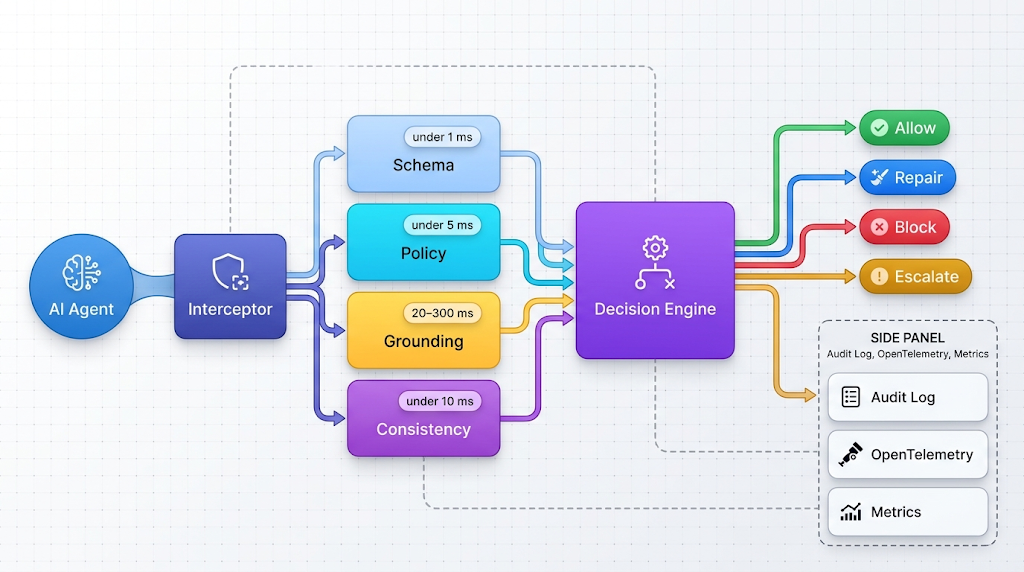
Reference Architecture: Anatomy of a Hallucination Firewall
Here is the high-level shape that most mature implementations converge on.
flowchart LR
    U[User or Trigger] --> A[AI Agent / LLM]
    A -->|Proposed output or tool call| I[Interceptor]
    I --> P{Validation Pipeline}
    P --> S[1. Schema Check]
    P --> R[2. Policy Engine]
    P --> G[3. Grounding Verifier]
    P --> C[4. Consistency Check]
    S --> D[Decision Engine]
    R --> D
    G --> D
    C --> D
    D -->|Allow| T[Tools / APIs / User]
    D -->|Repair| A
    D -->|Block| F[Safe Fallback]
    D -->|Escalate| H[LLM Judge or Human Review]
    D --> L[(Audit Log + Metrics)]
Let's break down each component.
1. The Interceptor
The interceptor is the choke point. Every message that leaves the agent must pass through it. In practice it's usually one of:
- An SDK wrapper around your tool-calling loop (simplest to start with)
- A sidecar proxy that sits between the agent runtime and tool servers, such as an MCP gateway
- An API gateway plugin for organizations that route all model traffic through a central LLM gateway
The golden rule: no tool should be reachable except through the interceptor. If an agent can call your billing API directly with its own credentials, your firewall is decorative.
2. The Validation Pipeline
This is a layered set of checks, ordered from cheapest to most expensive:
| Layer | What it checks | Typical latency | Example tools |
|---|---|---|---|
| Schema | Shape, types, enums, required fields | Under 1 ms | Pydantic, Zod, JSON Schema |
| Policy | Business rules, permissions, limits | 1 to 5 ms | Open Policy Agent (Rego), Cedar, custom rules |
| Grounding | Are claims backed by trusted sources? | 20 to 300 ms | Retrieval lookups, DB queries, NLI models |
| Consistency | Does output contradict context or itself? | 50 to 500 ms | Self-consistency sampling, small classifier models |
| Judge | Holistic review for high-risk cases | 500 ms and up | A separate LLM judge, Llama Guard-style classifiers |
The key insight is short-circuiting. If the schema check fails, there's no point paying for a grounding check. If an action is low-risk and passes schema and policy, you may skip the judge entirely.
3. The Decision Engine
The decision engine aggregates check results into one verdict. It's tempting to make this an LLM call. Don't. Keep it deterministic and boring. Auditors, on-call engineers, and future-you will all thank you when you can explain exactly why something was blocked.
4. Audit Log and Observability
Every decision gets logged with the input, output, checks run, scores, verdict, and latency. Modern teams emit these as OpenTelemetry spans using the GenAI semantic conventions so they show up next to normal service traces. This is what turns "the agent did something weird" into a debuggable incident.
Building One: A Practical Python Implementation
Enough theory. Let's build a minimal but realistic firewall for a customer-support agent that can look up orders and issue refunds.
We'll use Python 3.12, Pydantic v2 for schemas, and a simple pluggable check system. The code is intentionally framework-agnostic so you can drop it into LangGraph, the OpenAI Agents SDK, a custom loop, or anything else.
Step 1: Define Strict Schemas for Every Tool
The first and cheapest defense is refusing anything that doesn't match an exact contract.
# schemas.py
from decimal import Decimal
from enum import Enum
from pydantic import BaseModel, Field, ConfigDict


class RefundReason(str, Enum):
    DAMAGED = "damaged"
    LATE_DELIVERY = "late_delivery"
    WRONG_ITEM = "wrong_item"
    OTHER = "other"


class IssueRefundArgs(BaseModel):
    model_config = ConfigDict(extra="forbid", strict=True)

    order_id: str = Field(pattern=r"^ORD-\d{6}$")
    amount: Decimal = Field(gt=0, max_digits=8, decimal_places=2)
    reason: RefundReason
    customer_message: str = Field(max_length=1000)


TOOL_SCHEMAS = {
    "issue_refund": IssueRefundArgs,
}
Notice extra="forbid". If the model invents a field like override_policy: true, the call fails immediately. That single line stops a surprising number of structural hallucinations.
Step 2: Create a Common Check Interface
Every check returns the same result shape so the decision engine can treat them uniformly.
# checks/base.py
from dataclasses import dataclass, field
from enum import Enum
from typing import Any, Protocol


class Verdict(str, Enum):
    PASS = "pass"
    REPAIR = "repair"
    BLOCK = "block"
    ESCALATE = "escalate"


@dataclass
class CheckResult:
    check_name: str
    verdict: Verdict
    reason: str = ""
    score: float | None = None
    repaired_payload: dict[str, Any] | None = None
    metadata: dict[str, Any] = field(default_factory=dict)


@dataclass
class ToolCall:
    tool_name: str
    arguments: dict[str, Any]
    agent_id: str
    session_id: str
    context: dict[str, Any] = field(default_factory=dict)


class Check(Protocol):
    name: str
    async def run(self, call: ToolCall) -> CheckResult: ...
Step 3: Implement the Layered Checks
Schema check: fast and strict.
# checks/schema_check.py
from pydantic import ValidationError
from schemas import TOOL_SCHEMAS
from .base import Check, CheckResult, ToolCall, Verdict


class SchemaCheck:
    name = "schema"

    async def run(self, call: ToolCall) -> CheckResult:
        schema = TOOL_SCHEMAS.get(call.tool_name)
        if schema is None:
            return CheckResult(self.name, Verdict.BLOCK,
                               f"Unknown tool '{call.tool_name}'")
        try:
            schema.model_validate(call.arguments)
            return CheckResult(self.name, Verdict.PASS)
        except ValidationError as exc:
            return CheckResult(self.name, Verdict.BLOCK,
                               f"Schema violation: {exc.error_count()} errors",
                               metadata={"errors": exc.errors()})
Policy check: business rules the model must never override.
# checks/policy_check.py
from decimal import Decimal
from .base import CheckResult, ToolCall, Verdict

AUTO_APPROVE_LIMIT = Decimal("50.00")
HARD_LIMIT = Decimal("500.00")


class RefundPolicyCheck:
    name = "policy"

    async def run(self, call: ToolCall) -> CheckResult:
        if call.tool_name != "issue_refund":
            return CheckResult(self.name, Verdict.PASS)

        amount = Decimal(str(call.arguments["amount"]))
        if amount > HARD_LIMIT:
            return CheckResult(self.name, Verdict.BLOCK,
                               f"Refund {amount} exceeds hard limit")
        if amount > AUTO_APPROVE_LIMIT:
            return CheckResult(self.name, Verdict.ESCALATE,
                               f"Refund {amount} needs human approval")
        return CheckResult(self.name, Verdict.PASS)
In larger organizations, this logic usually lives in a policy engine like Open Policy Agent so security teams can update rules without redeploying the agent.
Grounding check: is the agent's claim actually true according to our systems of record?
# checks/grounding_check.py
from decimal import Decimal
from .base import CheckResult, ToolCall, Verdict


class OrderGroundingCheck:
    """Verify the refund matches a real order owned by this customer."""
    name = "grounding"

    def __init__(self, orders_repo):
        self.orders = orders_repo

    async def run(self, call: ToolCall) -> CheckResult:
        if call.tool_name != "issue_refund":
            return CheckResult(self.name, Verdict.PASS)

        order = await self.orders.get(call.arguments["order_id"])
        if order is None:
            return CheckResult(self.name, Verdict.BLOCK,
                               "Order does not exist (hallucinated ID)")

        if order.customer_id != call.context.get("customer_id"):
            return CheckResult(self.name, Verdict.BLOCK,
                               "Order belongs to a different customer")

        requested = Decimal(str(call.arguments["amount"]))
        refundable = order.total - order.refunded_amount
        if requested > refundable:
            return CheckResult(
                self.name, Verdict.REPAIR,
                f"Amount {requested} exceeds refundable {refundable}",
                repaired_payload={**call.arguments, "amount": str(refundable)},
            )
        return CheckResult(self.name, Verdict.PASS)
This is where the real value lives. The model can be as confident as it likes, but the database is the source of truth. Grounding against systems of record beats asking another model "is this true?" every single time it's possible.
Step 4: The Firewall Orchestrator
Now we wire it together with short-circuiting, timeouts, and fail-closed behavior.
# firewall.py
import asyncio
import logging
import time
from checks.base import CheckResult, ToolCall, Verdict

log = logging.getLogger("hallucination_firewall")

SEVERITY = {Verdict.PASS: 0, Verdict.REPAIR: 1,
            Verdict.ESCALATE: 2, Verdict.BLOCK: 3}


class HallucinationFirewall:
    def __init__(self, stages: list[list], timeout_s: float = 2.0):
        # Each stage is a list of checks that can run in parallel.
        self.stages = stages
        self.timeout_s = timeout_s

    async def _run_check(self, check, call: ToolCall) -> CheckResult:
        try:
            return await asyncio.wait_for(check.run(call), self.timeout_s)
        except asyncio.TimeoutError:
            return CheckResult(check.name, Verdict.BLOCK, "Check timed out")
        except Exception as exc:  # fail closed, never fail open
            log.exception("Check %s crashed", check.name)
            return CheckResult(check.name, Verdict.BLOCK, f"Check error: {exc}")

    async def evaluate(self, call: ToolCall) -> tuple[Verdict, list[CheckResult]]:
        started = time.perf_counter()
        results: list[CheckResult] = []

        for stage in self.stages:
            stage_results = await asyncio.gather(
                *(self._run_check(c, call) for c in stage)
            )
            results.extend(stage_results)
            worst = max(stage_results, key=lambda r: SEVERITY[r.verdict])
            if worst.verdict in (Verdict.BLOCK, Verdict.ESCALATE):
                break  # short-circuit: no need to run pricier checks

        final = max(results, key=lambda r: SEVERITY[r.verdict]).verdict
        log.info("firewall_decision", extra={
            "tool": call.tool_name,
            "session_id": call.session_id,
            "verdict": final.value,
            "checks": [(r.check_name, r.verdict.value, r.reason) for r in results],
            "latency_ms": round((time.perf_counter() - started) * 1000, 2),
        })
        return final, results
Step 5: Plug It Into the Agent Loop
# agent_runtime.py
from firewall import HallucinationFirewall
from checks.base import ToolCall, Verdict
from checks.schema_check import SchemaCheck
from checks.policy_check import RefundPolicyCheck
from checks.grounding_check import OrderGroundingCheck

firewall = HallucinationFirewall(stages=[
    [SchemaCheck()],                                # stage 1: cheapest
    [RefundPolicyCheck()],                          # stage 2: rules
    [OrderGroundingCheck(orders_repo)],             # stage 3: source of truth
])


async def execute_tool_call(call: ToolCall):
    verdict, results = await firewall.evaluate(call)

    match verdict:
        case Verdict.PASS:
            return await TOOLS[call.tool_name](**call.arguments)
        case Verdict.REPAIR:
            repaired = next(r.repaired_payload for r in results
                            if r.repaired_payload)
            return await TOOLS[call.tool_name](**repaired)
        case Verdict.ESCALATE:
            ticket = await review_queue.submit(call, results)
            return {"status": "pending_review", "ticket": ticket.id}
        case Verdict.BLOCK:
            reasons = "; ".join(r.reason for r in results if r.reason)
            # Feed the reason back so the agent can self-correct.
            return {"status": "blocked", "reason": reasons}
That last line matters more than it looks. Returning a clear, structured reason to the agent lets it retry with corrected arguments instead of hallucinating again. A firewall that only says "no" makes agents worse. A firewall that says "no, because X" makes them better.
Here's the Full Request Flow
sequenceDiagram
    participant Agent
    participant FW as Firewall
    participant DB as Orders DB
    participant Billing as Billing API
    participant Human as Review Queue

    Agent->>FW: issue_refund(ORD-104233, 75.00)
    FW->>FW: Schema check (pass)
    FW->>FW: Policy check (75 > 50 auto limit)
    FW-->>Human: Escalate with full context
    Human-->>FW: Approved
    FW->>DB: Verify order and refundable amount
    DB-->>FW: Order valid, 75.00 refundable
    FW->>Billing: Execute refund
    Billing-->>Agent: Success
Validating Free-Text Output, Not Just Tool Calls
Tool calls are the high-stakes path, but agents also write emails, summaries, and chat replies. For text, the main question is: is every factual claim supported by the context we actually gave the model?
A practical approach looks like this:
- Extract claims from the response (a small, fast model or a rules-based extractor works well).
- Match each claim against the retrieved documents or tool results in the session.
- Score support using a natural language inference (NLI) model or a lightweight judge.
- Strip or flag unsupported claims before the text reaches the user.
# checks/text_grounding.py
from dataclasses import dataclass


@dataclass
class Claim:
    text: str
    supported: bool
    evidence_id: str | None
    score: float


async def verify_response(response: str, evidence: list[dict],
                          extractor, nli_model,
                          threshold: float = 0.8) -> list[Claim]:
    claims = await extractor.extract(response)
    verified: list[Claim] = []
    for claim in claims:
        best_score, best_id = 0.0, None
        for doc in evidence:
            score = await nli_model.entailment(premise=doc["text"],
                                               hypothesis=claim)
            if score > best_score:
                best_score, best_id = score, doc["id"]
        verified.append(Claim(claim, best_score >= threshold,
                              best_id, best_score))
    return verified
In our refund example, the claim "per our updated policy you're eligible for 40% back" would find no supporting evidence in the session's retrieved policy documents, so the firewall would remove that sentence or block the whole message and ask the agent to regenerate it.
Real-World Examples Across Industries
Here's how the pattern shows up in different domains. The specifics change, but the architecture stays recognisably the same.
Fintech: The Payments Copilot
A payments operations agent drafts and executes vendor payouts. The firewall:
- Validates IBANs and routing numbers with checksum logic (deterministic, no model needed)
- Cross-checks payee names against the approved vendor master list
- Enforces dual approval above a threshold, mirroring existing human controls
- Blocks any payout to a vendor created in the last 24 hours, a classic fraud signal
The lesson: reuse the controls you already trust. If a human needs two approvals, so does the agent.
Healthcare: Clinical Documentation Assistant
An agent summarizes patient visits into structured notes. The firewall:
- Grounds every medication and dosage against the actual order system, not the transcript alone
- Flags any diagnosis code that doesn't appear in the encounter record
- Never auto-commits. Everything goes to a clinician for sign-off, with unsupported claims highlighted
Here the firewall's job isn't to block. It's to make human review fast and focused.
DevOps: The Incident-Response Agent
An SRE agent can restart services, scale deployments, and roll back releases. The firewall:
- Allows read-only actions (logs, metrics) freely
- Requires that any destructive action references a real, currently open incident ID
- Validates that target resources exist in the live inventory (agents love inventing pod names)
- Runs a dry-run first and diffs the plan, blocking anything that touches more than N resources
# firewall-policy.yaml (excerpt)
tools:
  kubectl_rollout_restart:
    risk: medium
    require:
      - incident_id_open: true
      - resource_exists: true
    limits:
      max_resources_per_call: 3
    on_violation: block

  kubectl_delete:
    risk: high
    require:
      - human_approval: true
      - dry_run_diff_reviewed: true
    on_violation: escalate
Declarative policy files like this one make the firewall reviewable by people who don't write Python, which is a big deal for security and compliance teams.
Best Practices for Production-Grade Firewalls
These are the habits that separate a demo from something you'd trust at 2 a.m.
- Fail closed for anything with side effects. If a check times out or crashes, the action does not happen. Read-only actions can fail open if you've consciously decided so.
- Classify every tool by risk. Read, write, and destructive actions deserve different pipelines. Don't run an expensive LLM judge on "get weather."
- Ground against systems of record first. A database lookup is cheaper, faster, and more reliable than a second model's opinion.
- Keep the decision engine deterministic. Use models as signals, not as the final authority.
- Give the agent actionable feedback. Structured block reasons enable self-correction and reduce retries.
- Version your policies like code. Store them in Git, require reviews, and run them through CI with test cases.
- Build a regression suite of known hallucinations. Every incident becomes a test case. Over time, this suite becomes one of your most valuable assets.
- Use least-privilege credentials. The agent should hold scoped, short-lived tokens. The firewall, not the agent, should be the only path to privileged credentials.
- Trace everything with OpenTelemetry. Firewall spans should sit alongside your service traces so incidents are debuggable end to end.
- Shadow mode before enforce mode. Run new checks in log-only mode for a week, measure false positives, then turn on enforcement.
Common Mistakes (and How to Avoid Them)
I've seen these patterns repeatedly in code reviews and post-mortems:
- Validating the prompt, not the output. Input filtering is useful against prompt injection, but hallucinations happen on the way out. You need both.
- Using the same model to check itself. A model asked "are you sure?" often doubles down. Use different models, different prompts, or, ideally, deterministic checks.
- Letting the agent bypass the firewall. If the agent's runtime has raw API keys, someone will eventually wire a tool directly. Network-level isolation and credential brokering fix this.
- Fail-open on errors. A crashed validator that silently returns "pass" is worse than no validator, because it creates false confidence.
- Blocking without explaining. Opaque refusals push agents into retry loops and frustrate users.
- Ignoring latency budgets. Stacking five LLM judges in series will make your agent unusable. Tier your checks and parallelize independent ones.
- No feedback loop. If blocked events never reach the team that tunes prompts and retrieval, the same hallucinations repeat forever.
- Treating it as a one-time project. Models change, tools change, and policies change. A firewall is a product with an owner, not a ticket you close.
🚀 Pro Tips
- Use a "confidence budget" per session. Each repaired or flagged output spends budget. When it runs out, the session automatically downgrades to read-only or hands off to a human. It's a simple circuit breaker that stops runaway agents.
- Canary your policy changes. Roll new rules to 5% of traffic first and compare block rates. A sudden spike usually means a bad rule, not a sudden wave of hallucinations.
- Hash and store the exact evidence used for grounding. When an auditor asks why something was allowed, you can show precisely which document version supported it.
- Watch agent-to-agent messages too. In multi-agent systems, put a lightweight firewall on internal handoffs. Hallucinations compound fastest in the gaps between agents.
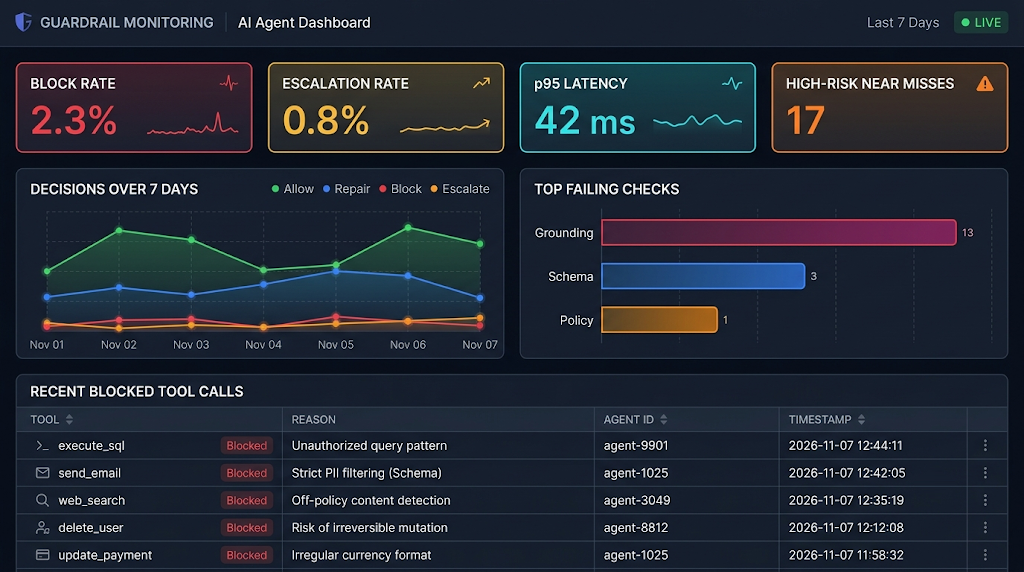
- Track "near misses" as a KPI. The count of blocked high-risk actions is one of the clearest ways to show leadership the firewall's value in plain business terms.
- Make the firewall reusable across agents. Package checks as a shared internal library or gateway service. The fifth agent your company ships should get protection on day one.
Why This Is a Lucrative Micro-Niche for Developers
Let's talk careers, because this is the part many readers care about most.
The Supply and Demand Gap
Building a good Hallucination Firewall requires an unusual combination of skills:
- Backend engineering: async pipelines, APIs, schemas, latency budgets
- Security thinking: threat modeling, least privilege, fail-closed design, audit trails
- ML literacy: how LLMs fail, how retrieval works, how to evaluate classifiers and judges
- Platform and SRE instincts: observability, rollouts, incident response
Most engineers are strong in one or two of these. Very few are comfortable in all four. Meanwhile, nearly every company deploying agents into real workflows needs this capability. That gap is exactly what makes a niche attractive: real demand, limited competition, and work that's directly tied to risk reduction, which is a budget line executives understand.
Roles You'll See in Job Listings
The titles are still settling, but you'll find this work under names like:
- AI Platform Security Engineer
- Agent Reliability Engineer
- LLM Guardrails Engineer
- AI Safety Engineer (applied or product-focused)
- DevSecOps Engineer with an AI or agent focus
Tip: search job boards for keywords like "guardrails," "agent safety," "LLM security," and "AI governance tooling" rather than relying on one fixed title.
A Practical 90-Day Roadmap
flowchart TD
    A[Days 1 to 30: Foundations] --> B[Days 31 to 60: Build]
    B --> C[Days 61 to 90: Prove It]
    A1[Study OWASP Top 10 for LLMs<br/>Learn Pydantic, OPA, OpenTelemetry] --> A
    B1[Build an open-source firewall<br/>for a sample agent with real tools] --> B
C1[Write a public case study<br/>with metrics and a red-team suite] --> C- Days 1 to 30: Learn the risk landscape (OWASP LLM Top 10, NIST AI RMF), and get comfortable with schema validation, policy engines, and tracing.
- Days 31 to 60: Build a small agent with real tools (a fake bank, a fake ticketing system) and wrap it in a firewall like the one above.
- Days 61 to 90: Red-team your own agent, document what the firewall caught, publish the repo and a write-up. A portfolio piece with real block-rate metrics is far more convincing than a certificate.
Conclusion
AI agents are here to stay, and they're getting more capable and more autonomous every quarter. But capability without control is just risk with a nicer interface.
A Hallucination Firewall is how engineering teams make that trade-off explicit. It doesn't make models perfect. It makes their mistakes visible, containable, and recoverable. It treats model output as untrusted input, grounds claims against real systems of record, enforces policy deterministically, and leaves an audit trail that security and compliance teams can actually use.
If you're a developer looking for a place where backend skills, security thinking, and AI knowledge overlap, this is one of the most practical and in-demand areas to grow into right now. Start small: wrap one tool, write three checks, log every decision. You'll learn more from that one exercise than from a dozen blog posts. Including this one.
📌 Key Takeaways
- A Hallucination Firewall intercepts every agent output and tool call, then allows, repairs, blocks, or escalates it.
- Treat LLM output as untrusted input. Same mindset as validating a web form.
- Layer your checks from cheap to expensive: schema, policy, grounding, consistency, judge. Short-circuit early.
- Ground against systems of record whenever possible. Databases beat second opinions from another model.
- Fail closed for side-effecting actions and keep the decision engine deterministic.
- Log and trace everything, and turn every incident into a regression test.
- The skill mix (backend, security, ML, SRE) is rare, which makes this a high-demand, lower-competition career path in 2026.
References
- OWASP Top 10 for Large Language Model Applications
- NIST AI Risk Management Framework (AI RMF 1.0)
- EU Artificial Intelligence Act overview
- Model Context Protocol specification
- NVIDIA NeMo Guardrails (GitHub)
- Guardrails AI (GitHub)
- Pydantic documentation
- Open Policy Agent documentation
- OpenTelemetry semantic conventions for generative AI
- Llama Guard: LLM-based Input-Output Safeguard for Human-AI Conversations (arXiv)